
The problem is rarely the interface. It's the decision infrastructure underneath.

Fractional product leadership for AI-native products that decide, recommend, and automate. I resolve the product decisions holding up progress, then carry them through design and into running code.

For founders, CEOs, CTOs, and product leaders at seed to Series B AI-native companies.

Thirty minutes. Bring what's stuck. No deck, no pitch. If it isn't work I do, I say so.

Booking one-week System Reads now. Open to a longer engagement.
Why people reach out

The product works. It still needs too much help to succeed.

Your team already ships with AI. What is usually missing is the decision infrastructure: the product logic, evidence, and controls that turn raw model capability into something customers can actually use.

Most useful when adoption depends on trust, control, workflow, or operational judgment.

Usually someone has already tried the obvious moves: a contract designer, a redesign, another round of onboarding. Activation still does not move, or every new customer still needs a person in the loop.

You already have people building. A release or a new customer need has exposed decisions the team hasn't resolved. I work alongside the product or engineering lead to settle the direction and carry it through design, engineering, and implementation.

Case study

NºWho it was forCame in withLeft with

An applied AI platform used in high-consequence work.

The product worked. Nobody could point to the screen where it lost people, and every new account still took hands from the team.

A scoped design engagement became standing product and design direction.

An opaque system became legible. The screens barely changed.

Endorsement

Hew's insights caused us to change engineering direction and product narrative.

Having experience working with product designers and design thinking over the last 15 years, Hew blew me away with the first-principles approach he took with understanding our product, use cases, customer experience vision, and the technical nuance and challenges that abounded in our solution space. Hew was a wonderful thought partner that thrived in ambiguity and only needed slight direction before having enough with which to work.

From an engineering perspective, we pivoted to a more integrated UI and backend design as a direct result of Hew calling out the need for better transparency, the need for easy evidence inspection, and making complexity accessible behind a simple UI. Additionally, Hew helped us see our product from a higher level to enable us to more clearly communicate how we solve customer needs in a delightful and unique way.

Hew was thoughtful, creative, inspiring, respectful, curious, and bold enough to challenge our thinking. Hew will be my first call when I need product design or product vision work in the future.

The Decision Read v2.2.3

Bring a situation. See what the method notices.

Start with how your team makes product decisions. If it is not work I do, I will tell you that too.

I test each version against cases it should turn away. If it recommends me too often, I don't publish it.

Get in touch Free. No signup.

The Decision Read applies the Bayesian Leaf methods to your situation. Your answers are used only to generate the read, and I don't see them unless you choose to send it to me afterwards.

01 / 06
Reading your situation…

The Decision Read v2.2.3 · running the Bayesian Leaf method

Your read

Send me your read

Leave it with me and I'll reach back out.
Your read and your answers come with it, so when I get back to you, I already know your situation.
The read you're sending

Your answers are sent to Anthropic's API to write the read. I never see them unless you choose to send the read to me. No signup.

Got it. I'll be in touch.
I read every message personally, and I'll come back to you with your read in hand.
Ready

Selected writing

ForthcomingNotes and essays as new thoughts, discoveries, and outcomes arise.

See all writing Subscribe on Substack

Engagement

What it costs, and what you get

You're buying the judgment that decides what gets built.

The working session comes first. For a Direction Sprint or a Standing Engagement, I scope the proposal after I understand the work. I take one longer engagement at a time.

System Read One week
Read the product from the codebase outward.
Give me repo and product access, read-only. The code is the brief. Then two or three conversations.
$9K
Good for
Three people on your team have three different explanations for why new customers stall, and each is partly right. With nothing to check them against, the quarter goes to whoever argues best.
What's produced
  • A written read of the system: file paths, line references, the gap between product and interface.
  • The decision the product is waiting on, named.
  • A focused working prototype that demonstrates one proposed change addressing the identified gap.
What changes
You spend the quarter on the right problem. The written read stays in use after the week ends, and it can contradict what the team believed going in.
Direction Sprint Four weeks
Work with you to set a direction your team can carry.
Four weeks alongside a team that keeps shipping. A read finds the gap. A sprint resolves it.
$25K
Good for
A product launch or significant change is coming. The team needs to agree on what to build and how it should work.
What's produced
  • A direction document with named principles the team can argue with.
  • A running high-fidelity prototype with the direction inside it.
  • The sequence the team can carry after I leave.
What changes
The team can commit to a direction and argue with it, instead of relitigating strategy every sprint.
Standing Engagement Monthly
Keep the hard decisions moving while the team ships.
Works alongside whoever owns product, or fills the seat if no one does. A sprint ends; this does not.
$12K to $20K/mo $12K holds the direction; adding execution moves it toward $20K.
Good for
You need an experienced partner alongside the team to make product decisions and, when the work calls for it, carry them through design and implementation.
What's produced
  • Decisions written clearly enough for the team to build against.
  • Product direction and release sequence kept current as the work changes.
  • Hands-on product and design work in the months that need it.
What changes
Product decisions stop waiting on one person's calendar.

Endorsement

He was able to see the whole picture clearly and focus exactly on what would need his effort the most.

I really appreciated the collaborative approach Hew brought to our product team. Hew is thoughtful and receptive throughout the design review process, taking feedback well and helping create a productive environment for workshopping ideas and exploring different directions.

Hew was also willing to think beyond individual design questions and engage with broader product considerations, which gave the team another perspective as we worked through ideas and decisions. Hew always brought in additional expertise, research, and outside perspectives to help us think through potential approaches we wouldn't have considered otherwise.

Product Manager, applied AI platform
First two weeks of engagementWhat happensWhat I need from you
Day one

A 30-minute working session. No deck, no pitch. Bring whatever is stuck, and we find the one decision the rest is waiting on.

Thirty minutes, and whoever owns the product decision.

Week one

A read-only pass through the codebase, then the first written read. The work starts from what is already true.

Repo access, read-only. Product access.

Week two

The first direction, or a working prototype, in front of the team. For a System Read, week one is the whole engagement, prototype included.

For a Standing Engagement, time from your side, set in the monthly scope.

The system knows more than the interface says, and more than the people running it remember.

The method

The work moves from the system itself
to a direction the team can carry.

01

Map the system

Most of the problem is already visible. It has rarely been drawn in one place.

02

Find the load-bearing decision

Until it is named, the roadmap stays full of plausible directions.

03

Make it legible

A person should understand what to do and why, without being taught. This is where design earns its place. Not as the fix, but as how the decision becomes something a team can build against.

04

Build the trust layer

AI changes what a person has to believe before they act. Trust has an anatomy: the evidence, the controls, the way back when it's wrong. I design that.

05

Ground it in measurement

If we can't tell what changed after release, we don't know whether the decision made the product better.

06

Sequence for compounding

I order the work so each release makes the next one easier. That's what compounds.

About View full work »

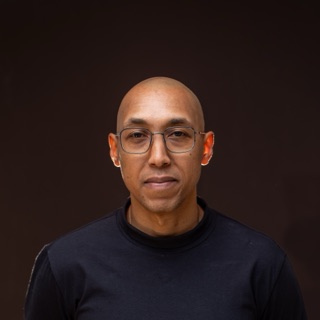
Hew Suber, MBA

Eighteen years building decision-heavy product systems across Meta, Pinterest, Opendoor, and early-stage companies. At Pinterest that meant an AI automation product built from nothing, where more than thirty setup decisions collapsed into three inputs. It cleared its first-year target by 57 percent. The work spans automation, self-serve, operational modeling, and AI-native products, including embedded product and design work across a Techstars Atlanta cohort.

I work where product, design, and engineering have become the same problem. Every engagement is with me, start to finish, with no handoff. I read the codebase before I design, so what I hand back is grounded in what the system can actually do. The team knows what is hard and what only sounds hard before it commits.

Outside client work, I build consumer products, Sage Orange and Presence, under Human Commons.

Hew Suber

Let's talk

Bring what's stuck.

Send a note, or book the session directly. Both reach me.

Not a fit: teams still looking for the product, or teams that want a pair of hands for a backlog they have already decided. If it isn't work I do, I say so on that call and point you to someone better.

Send a note

Atlanta, GA · Working worldwide

Book a working session